

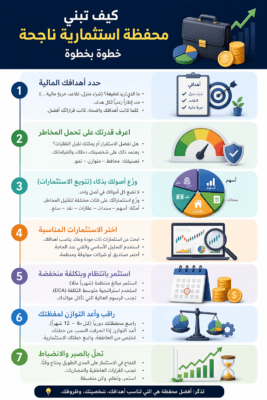
How to Build a Successful Investment Portfolio in 2026 for Sustainable Financial Growth Today, as we navigate economic volatility and rapidly evolving financial markets, building a well-structured and resilient investment portfolio is no longer a luxury—it’s a necessity. This shift aligns with ambitious economic transformations such as Saudi Arabia’s Vision 2030.
The real question is no longer “Should I invest?” but rather “How do I build a successful investment portfolio step by step to achieve stability and growth?”
In this professional guide, you’ll learn a clear and practical methodology for building investment portfolios—from setting objectives to managing risks and rebalancing—using an approach suitable for both beginners and experienced investors.
What Is an Investment Portfolio?
An investment portfolio is a structured plan for allocating your money across a range of assets, such as:
- Stocks
- Bonds
- Investment funds
- Alternative assets (such as real estate or gold)
Today, many individuals and investors are turning to portfolio creation because it helps to:
- Reduce risk through diversification
- Achieve sustainable long-term returns
- Protect capital from inflation
- Reach financial goals such as retirement or financial independence
Studies indicate that over 80% of investment success depends on asset allocation, not just asset selection.
Professional Steps to Build a Successful Investment Portfolio
Building a successful portfolio requires following a set of well-defined steps:
1. Define Your Investment Goal
Start by clearly identifying your objective, as every decision you make afterward depends on it.
Types of goals:
- Capital growth (long-term)
- Stable monthly income
- Capital preservation
Each goal requires a different strategy, so clarity is the first step toward success.
2. Determine Your Time Horizon
The duration of your investment directly impacts your strategy:
| Time Frame | Investment Type |
|---|---|
| Less than 3 years | Low risk |
| 3–7 years | Balanced |
| More than 7 years | High growth |
The longer your investment horizon, the greater your ability to withstand market fluctuations.
3. Assess Your Risk Tolerance
Ask yourself:
- Can you handle losses at the beginning of your investment journey?
- Do you feel anxious when markets decline?
Investors generally fall into three categories:
- Conservative
- Balanced
- Aggressive
Studies show that investors who understand their risk tolerance and can handle market volatility achieve up to 30% better results.
4. Asset Allocation (The Most Important Step)
This step accounts for nearly 80% of portfolio success. A professional allocation model may look like this:
- 60% Stocks
- 25% Bonds
- 10% Investment funds
- 5% Cash
5. Continuous Monitoring and Analysis
You should regularly track your portfolio performance using:
- Annual returns
- Risk level
- Market benchmarks
The goal is not just monitoring, but continuously improving performance.
Choosing the Right Investment Tools
After defining the core steps, it’s time to select the actual investment instruments:
Stocks
- Invest through a financial advisory firm
- Dividend-paying stocks
Funds
- Exchange-Traded Funds (ETFs)
- Income funds
Bonds
- Government bonds (lower risk)
- Corporate bonds (higher returns)
Common Mistakes to Avoid
- Investing without a plan
- Relying on a single source of income
- Following rumors and market noise
- Selling during losses
- Lack of diversification
Conclusion
Building a successful investment portfolio is not a matter of luck—it’s a structured process that requires discipline, clear standards, and patience during market fluctuations.
By following these steps, you will:
- Reduce risks
- Achieve sustainable growth
- Move closer to your financial goals with confidence
Start today—and start the right way. Every smart investment you make today is a step toward financial freedom tomorrow.